
MODERN AIRPORT RENOVATION: MANAGING CONSTRUCTION IN ACTIVE TERMINALS WITH TEMPORARY WALLS
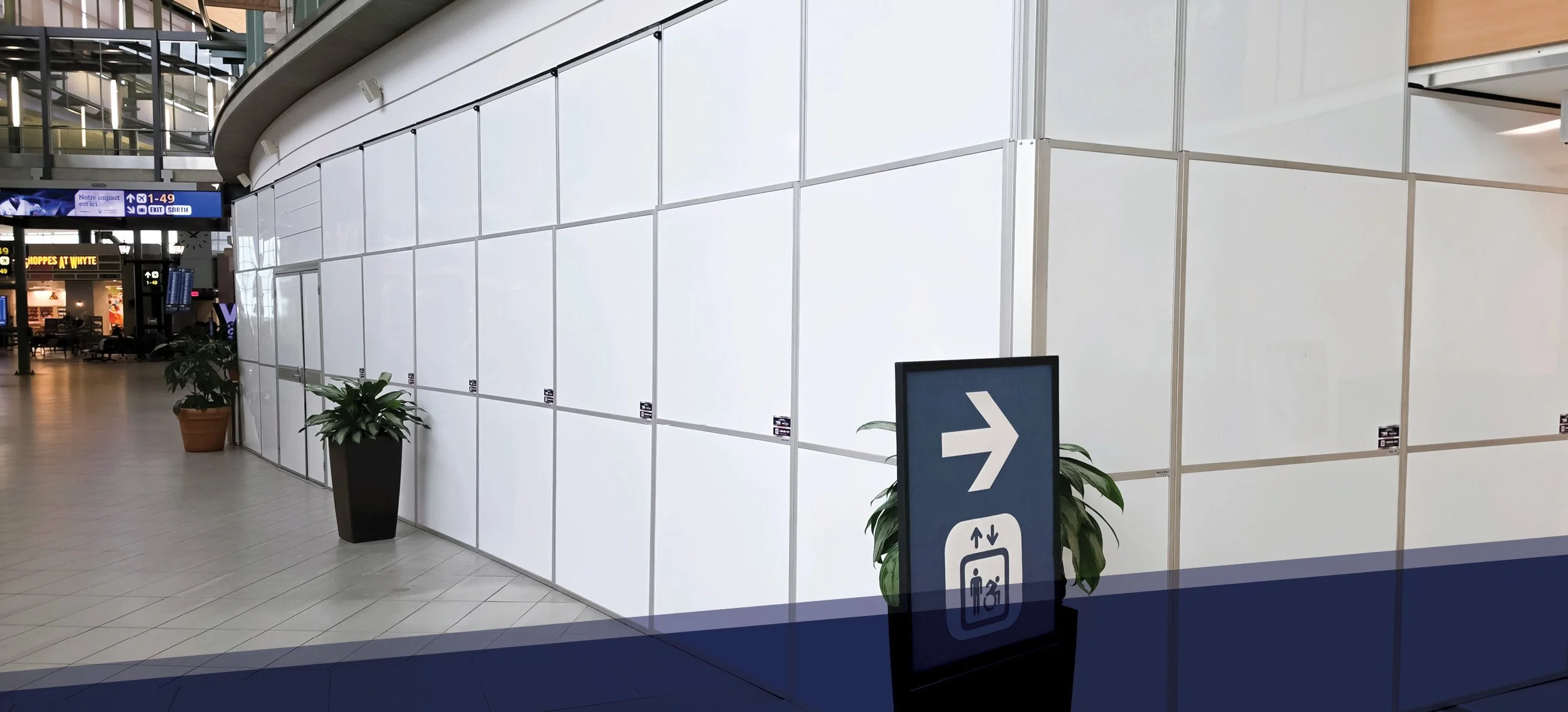
Airport construction and renovations require construction containment to protect passenger health, maintain operational security, and preserve daily business continuity in high-traffic environments.
Traditional construction containment methods such as plastic sheeting (poly) and unfinished drywall hoarding can create significant challenges in active airport terminals.
SHIELD WALL™ addresses all the major operational, financial, and logistical risks of using traditional construction containment methods and is an ideal solution for airport terminal construction and renovations.
Managing construction and renovations in active airport terminals presents a unique operational challenge: upgrading infrastructure must happen without pausing flights, compromising security, or disrupting passenger flow. Uncontained dust, excessive construction noise, and visual clutter directly threaten passenger satisfaction and facility navigation. To modernize terminal spaces efficiently, facility managers and general contractors are increasingly replacing traditional drywall and plastic sheeting construction containment with reusable modular wall systems.
Operational Risks of Traditional Airport Construction Containment
Active construction in busy airports significantly impacts both operations and the passenger experience. Using traditional plastic sheeting or unfinished drywall hoarding can make active terminals look messy and unprofessional. These work zones may suffer from:
Poor containment that allows dust and airborne particulates to drift into public spaces.
Physical and visual clutter that disrupts passenger navigation.
Security vulnerabilities, leaving openings for unauthorized individuals to enter unsafe work areas.
Excessive skilled labor requirements and billable hours for setup and teardown, extending project timelines.
Higher overhead through single-use material waste and recurring disposal fees.
How Reusable Modular Systems Like the SHIELD WALL™ Mitigate Construction Risks
Upgrading from disposable containment to a high-performance, reusable temporary wall system fundamentally transforms how airport construction is managed. Temporary modular walls are designed specifically for demanding, high-traffic environments, and help eliminate the waste and inefficiencies of traditional methods.
While the technical capabilities of temporary wall systems go far beyond what drywall or poly can achieve, they also hold an advantage in their installation. SHIELD WALL™ panels use either a tool-free drop-in connector or simple bracket system. They can be constructed quickly and connected seamlessly without drilling into or damaging existing airport floors or ceilings.
SHIELD WALL™ is easily scalable to project sizes, adjusting from standard 7'–10'3" heights up to 32' with specialized bracketing to enclose large terminals. Additionally, SHIELD WALL™ helps dampen construction noise up to approximately 17dB, and exceeds ASTM Class A fire ratings.
Key Benefits for Airport Facility Management & Operations Teams
Maintains Terminal Aesthetics & Branding: Smooth, white-painted aluminum panel exteriors deliver a clean, finished appearance that can accept full-bleed graphic wraps for airport messaging, wayfinding, or commercial advertising.
Enhanced Security & Access Control: Rigid panels integrate with swing or sliding doors featuring key locksets or digital keypads to actively deter unauthorized worksite entry.
Minimal Infrastructure Damage: Quick-connect panels and non-invasive bracketing help protect terminal finishes from drill holes and structural wear.
Why General Contractors Choose Modular Walls for Terminal Projects
Considerable Time & Labor Savings: A two-person crew can erect 30 linear feet of wall in 15 to 30 minutes (or 100 feet in under an hour), a fraction of the time required for traditional drywall.
Multi-Phase Adaptability: Reusable panels dismantle quickly and reconfigure easily as work moves across multi-phase construction plans.
Significant Cost Savings & ROI: Reusable systems eliminate recurring single-use material costs and landfill fees, resulting in a positive ROI in as few as 3 to 5 uses.
Direct Comparison: Traditional Containment vs. SHIELD WALL™
The comparison below highlights how traditional construction containment stacks up against SHIELD WALL™ reusable modular wall systems across core operational and financial metrics:
| FEATURE / BENEFIT | TRADITIONAL CONTAINMENT (DRYWALL / POLY) |
SHIELD WALL™ REUSABLE MODULAR WALL SYSTEMS |
| Environmental & Financial Impacts | Single-use; costly disposal | Reusable; pays for itself in 3-5 uses |
| Labor & Installation | Labor-intensive, time-consuming during billable hours | Quick, easy modular setup |
| Damage Impact | Risk of ceiling/floor damage from construction | Non-invasive bracketing mitigates risk of damage to floors, walls, and ceilings |
| Sound Attenuation | None (poly); modest at best (drywall) | Up to ~17 dB reduction |
| Compliance & Safety | Limited compliance | Exceeds ASTM Class A fire ratings |
| Aesthetics & Customization | Messy, limited adaptability, unattractive | Clean, modular, configurable, multiple materials and options, supports graphic wraps and ads |
| Security | Flimsy and insecure materials are easy to breach | Solid walls with multiple door and locking options |
Conclusion
Modernizing airport infrastructure doesn't have to compromise the passenger experience, terminal security, or strict project timelines. By shifting to modular temporary wall solutions, facility teams and contractors can streamline active terminal renovations safely and efficiently.
Ready to streamline your next terminal upgrade? Download our SHIELD WALL™ and SHIELD WALL CONNECT catalogs, or connect with our team of specialists to find the right SHIELD WALL™ modular solution for your project.